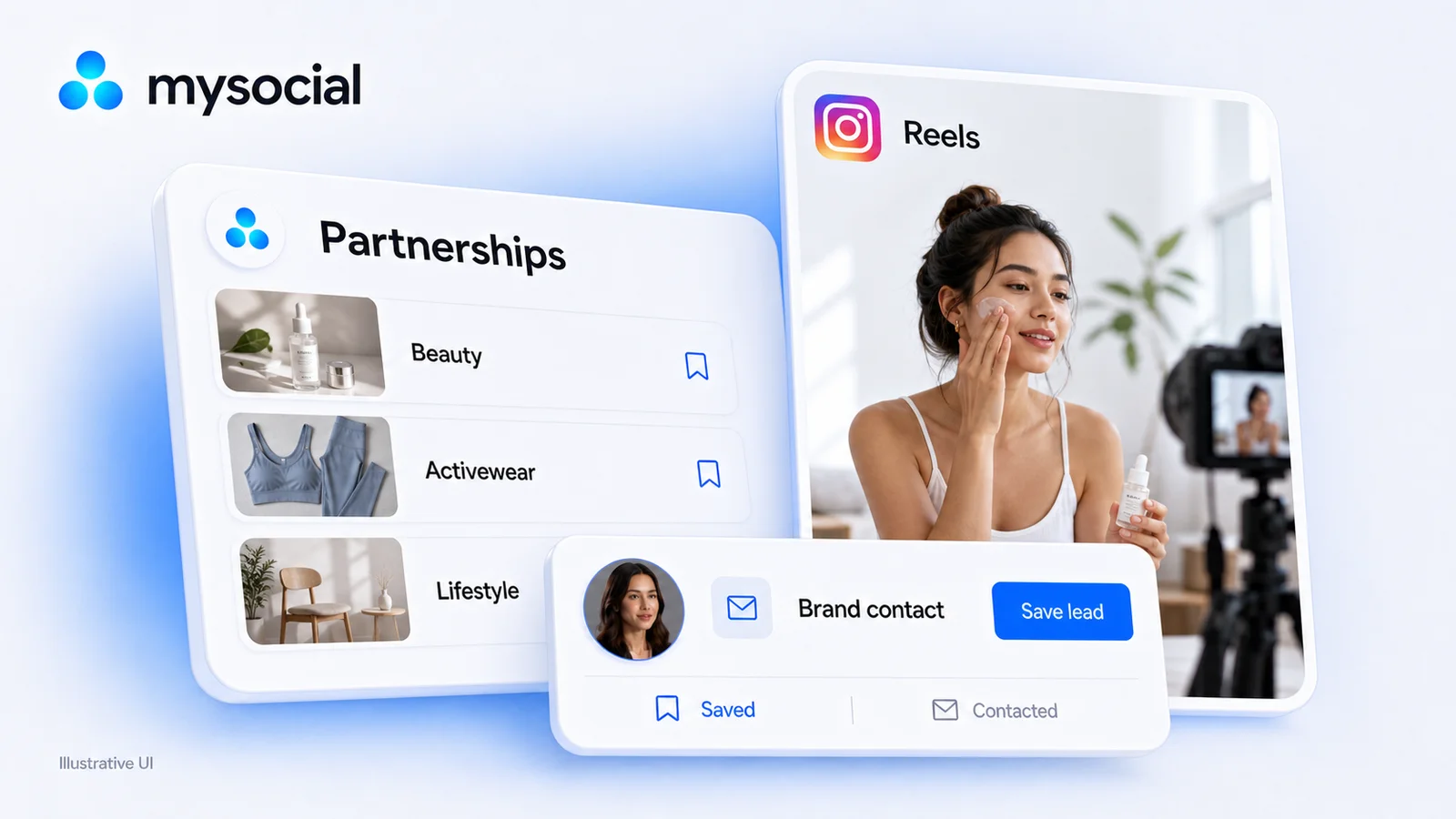
Best Instagram Sponsorship Platforms for Creators
Compare Instagram sponsorship platforms for Reels, Stories and brand deals. See creator fees, campaign types and the best fit for your next partnership.


Quick answers
There is no fixed Instagram influencer salary. Collabstr’s 2026 report records an average Instagram collaboration payout of $193 in its 2025 marketplace data. That is a sampled payment per collaboration, not monthly income or a price for every creator.
Follower count alone cannot tell you. Calculate income from actual brand deals, approved affiliate earnings and available platform payouts, then subtract costs. Separate agreed work, completed work and money received; do not treat an unanswered pitch as earnings.
Instagram income comes from paid work and other actual revenue, not a fixed payment for each follower. Start by checking whether a real offer fits your content and leaves enough after the work involved.
Replace the brackets with the offer and dates. Without Mysocial, paste the offer and relevant captions or source notes into your assistant, or work through the tables below yourself. A missing fee or payment term stays unknown.
In its 2026 Influencer Marketing Report, Collabstr reports these Instagram figures from its own marketplace data for 2025, reviewed here on October 15, 2026:
| Measure | Reported USD amount | What it describes |
|---|---|---|
| Average listed Instagram package | $214 | What creators offered to charge |
| Average Instagram collaboration payout | $193 | The negotiated payment recorded for a collaboration |
The report analyzes more than 21,000 collaborations across platforms. These averages describe that marketplace sample. They are neither a monthly salary nor a follower-tier or format-specific rate card. Neither figure is take-home income after expenses or fees. Do not multiply either figure by your follower count. Collabstr’s original report.
For a quote on a particular deliverable, use the separate Instagram influencer pricing guide. This page answers the different question: what income does the work actually produce?
They describe audience size. They do not supply the missing deal fee, number of paid jobs, sales, costs or payment date.
| Search question | What you need to calculate the answer |
|---|---|
| How much can 10K followers earn? | Actual paid work or another revenue source; a follower threshold is not an offer |
| What is the income from 20K Instagram followers? | Agreed fees and deliverables, completed work, approved commissions and costs for a named period |
| What is a 500K-follower Instagram salary per month? | That creator’s actual monthly revenue records and expenses; size alone does not establish a salary |
A creator can have a large audience and no paid work in a particular month. Another can earn through a small number of relevant partnerships or their own products. Neither situation gives you a universal rate for an account of the same size.
Choose one currency and a calendar period. Use a revenue record for every line:
| Income source | Evidence to use | Keep separate |
|---|---|---|
| Brand collaborations | Agreed scope, fee, completion record and payment status | A proposal, an invoice and cash received |
| Affiliate work | The program’s approved commission statement | Pending or reversed commissions |
| Platform monetization | Your own eligible account’s earnings or payout statement | An available feature and an actual payout |
| Your products or services | Sales records and relevant costs | Sales revenue and the creator’s take-home amount |
Meta describes tools such as Subscriptions and Gifts, with availability and eligibility conditions. Its overview is dated; check what your own professional dashboard currently offers before including any platform income. Do not assume a bonus, payment per view or subscription income simply because an account has followers. Meta’s creator monetization overview.
For a simple planning worksheet:
PERIOD AND CURRENCY:
Brand fees for work completed:
Approved affiliate commissions:
Platform earnings shown in my records:
Other creator revenue:
TOTAL REVENUE:

Production and editing costs:
Other costs included in this calculation:
REVENUE MINUS INCLUDED COSTS:

CASH ACTUALLY RECEIVED:
Unpaid invoices / pending amounts:
Excluded costs and unknowns:
Choose and label a consistent basis. If you compare completed work, show when it was completed. If you need cash available this month, use receipts. This worksheet is a planning aid; it does not calculate tax or replace your accounting records.
Original fictional teaching example, in USD. These inputs are not market rates, a customer result or a forecast.
A desk-setup creator has 20,000 Instagram followers. For the chosen month, their own supplied records show two completed collaborations at $350 each, $60 in approved affiliate earnings and $80 in platform earnings. Included production costs total $140.
| Calculation from the example inputs | Amount |
|---|---|
| Two completed collaborations: 2 × $350 | $700 |
| Approved affiliate earnings | $60 |
| Platform earnings in the supplied record | $80 |
| Total revenue | $840 |
| Minus included production costs | −$140 |
| Revenue minus included costs, before tax and any excluded costs | $700 |
Suppose only $350 of those collaboration fees has been received, while the other $350 is still unpaid. Even if the other revenue has arrived, cash received is $490, not $840. Revenue, outstanding payments and money available to spend answer different questions.
Now a brand offers $400 for a Reel plus a Story set. Extra production costs are $90, estimated work is six hours, and the usage-rights duration is missing. Here is the useful reviewed output to ask for:
| Review item | Example conclusion |
|---|---|
| Content fit | The creator supplies two desk-setup posts showing the product category in use; those support topic fit, not guaranteed sales |
| Incremental revenue minus stated costs | $400 − $90 = $310, before tax and any excluded costs |
| Workload check | $310 ÷ 6 = about $51.67 per estimated hour, using only these inputs; not a market wage benchmark |
| Missing terms | Usage duration, ad use, revisions and payment date need clarification |
| Decision | Clarify or renegotiate before accepting. Do not count an unsigned offer as confirmed income |
The assistant should identify the actual source posts it inspected. If those posts or the relationship record are unavailable, it should say so instead of inventing a fit story. Use an influencer pitch template when you are ready to draft a specific reply for human review.
Give it the actual work: format, quantity, deadline, revision expectations, exclusivity and intended content use. Add your costs and available time. Treat a gifted product separately from a cash fee, and do not estimate sales from likes or views.
Ask the assistant to show each amount’s source and arithmetic. It should keep a missing cost unknown, flag incomplete records and distinguish a promising brand from an agreed paying client. Use your own decision criteria rather than an invented “standard” pay-per-follower formula.
For the next step, prepare a media kit with evidence you can support, or research relevant brand partnerships. Mysocial helps organize available content and relationship context; it does not guarantee a fee, collect payment or accept the deal for you.
Creator Monetization & Brand Deals
Related Posts
Compare Instagram sponsorship platforms for Reels, Stories and brand deals. See creator fees, campaign types and the best fit for your next partnership.

Plan esports sponsorship with an inventory worksheet, permission checks and a worked activation example. Research suitable brands before pitching.

Calculate earned media value with a clear formula and worked example. Choose defensible CPM inputs and report campaign outcomes alongside EMV.