
10 Must-Have Tools Every Influencer Needs
The best tools for influencers to create content, find sponsors, grow followers, and manage social media like a pro.

Quick answers
A professional media kit needs eight sections: bio and positioning statement, platform stats with engagement rates, audience demographics, content examples, past brand collaborations with results, rate card with tiered packages, social proof and testimonials, and contact information. Every section should include real, verifiable data — 87% of brands require media kits before initiating partnerships.
One to three pages. Brands review dozens of kits and spend an average of 30 seconds scanning before deciding. Lead with your strongest numbers and keep everything scannable. A clean, data-forward kit beats a 10-page PDF every time. If you use a live media kit link, there is no page limit — brands scroll as deep as they want.
Your media kit should always reflect your current numbers. Manually updating a PDF monthly is unrealistic — use a tool like MySocial that auto-updates your stats daily. 78% of brands verify influencer metrics before partnerships, and outdated data kills deals. Creators with auto-updating kits earn 35-60% more per campaign.
Yes — at least a starting range or tiered packages. 78% of brands expect creators to provide rate cards before negotiating. Including rates signals professionalism, filters out brands that cannot afford you, and prevents the awkward "what is your budget?" back-and-forth. Structure rates by deliverable type and platform.
Lead with engagement rate and audience quality. A creator with 5K followers and 6% engagement is more valuable to brands than one with 50K followers and 0.5% engagement. Showcase your best-performing organic posts with metrics, include audience demographics, and highlight your niche authority — brands hire for audience access, not follower count.
87% of brands require media kits before initiating partnerships (InfluenceFlow, 2026). Your media kit isn’t a formality — it’s the document that determines whether a brand replies to your pitch or moves on to the next creator in their inbox.
The difference between creators landing $500 deals and those landing $5,000+ deals is rarely follower count. It’s how professionally they present themselves. Creators with professional media kits receive 3.5× more sponsorship inquiries and earn 35-60% more per campaign than those without them.
Most media kits fail for one of two reasons: they’re either a wall of text about the creator’s “passion for content,” or a screenshot dump with no context. Brands don’t care about your journey. They care about three things — who your audience is, how engaged they are, and whether you can prove results.
87%
Of brands require media kits before initiating partnerships
3.5×
More sponsorship inquiries with a professional media kit
30s
Average time a brand spends scanning a media kit before deciding
78%
Of brands verify creator metrics before partnership
Each section answers a specific question a brand is asking. Miss one and you create doubt. Include all eight and you remove every reason to say no.
Anatomy of a Winning Media Kit
Bio & Positioning
Who you are, who you serve, why brands should care
Platform Stats
Followers, engagement rate, avg views, monthly reach
Audience Demographics
Age, gender, location, interests, purchasing power
Content Examples
3-5 best posts with format, views, and engagement
Past Collaborations
Brand logos, campaign screenshots, results driven
Rate Card & Packages
Deliverable pricing, tiered bundles, add-ons
Social Proof
Brand testimonials, press mentions, awards
Contact & Links
Email, socials, media kit link, booking info
Two to three sentences maximum. Who you are, who your audience is, and what makes your content valuable to brands. This is not your life story — it's your value proposition.
Good: 'Fitness creator helping busy professionals build sustainable workout habits. 85K engaged followers across Instagram and TikTok, 4.8% average engagement rate. Past partners: Nike, Gymshark, Huel.'
Bad: 'I've always been passionate about fitness and started creating content in 2019 because I wanted to share my journey...'
The first tells a brand exactly what they'll get. The second tells them nothing actionable.
Follower count alone is meaningless — 72% of brands now prioritize engagement rate over follower count. For each platform, include:
• Followers (current, verified)
• Engagement rate — Instagram average is 1.5%, TikTok is 2-3%. Anything above 3-5% is strong
• Average views per post — more useful than follower count for predicting campaign reach
• Monthly reach / impressions
• 30-day growth rate — shows momentum
Pull these from your analytics dashboard so they're accurate and verifiable. Brands cross-check — 78% verify metrics before partnerships.
This is what brands actually pay for — access to a specific audience. A beauty brand needs to see that 70% of your audience is women aged 18-34 in the US, not just that you have 50K followers.
Include:
• Age distribution — top 2-3 age brackets with percentages
• Gender split — e.g., '72% female, 28% male'
• Top locations — countries and cities
• Primary interests — what your audience cares about beyond your niche
• Income / education level (if available) — especially valuable for premium brands
Verified demographic data is a dealmaker. Brands hire for audience access, not follower count.
Three to five of your best posts — ideally a mix of organic and sponsored content. For each, include:
• Format — Reel, carousel, Story, TikTok, YouTube video
• Views / reach
• Engagement rate for that specific post
• Brief note on why it performed well
If you've done sponsored content, include those examples specifically. This shows brands what their content will look like on your feed. A brand seeing a polished sponsored Reel that got 4.2% engagement is far more convincing than a grid of organic selfies.
This is the section that separates professionals from beginners. List 3-5 past partnerships with specific results:
• Brand name and what you created
• Reach / impressions the content generated
• Engagement rate on the sponsored content
• Click-throughs, promo code redemptions, or sales if you have them
No results yet? Show your best-performing organic content with metrics instead. Even if the numbers are modest, having documented results proves you track performance and take partnerships seriously.
78% of brands expect creators to provide rate cards before negotiating. Structure your pricing in tiered packages:
Per-deliverable rates: Single Instagram Reel, TikTok video, YouTube integration, Story set, etc.
Bundled packages: Starter (1 post), Growth (3 posts + Stories), Premium (multi-platform + whitelisting)
Add-on pricing: Usage rights extension, exclusivity, whitelisting, raw footage
Need help setting rates? See how much to charge for a brand deal for benchmarks by tier and platform.
If a brand you've worked with said something positive, quote them. Even a single line from a marketing manager — 'Working with [you] drove our highest engagement of the quarter' — adds enormous credibility.
Also include:
• Press mentions — featured in, interviewed by, quoted in
• Awards or milestones — 'Creator of the Year,' top X% of creators
• Notable audience moments — viral posts, trending hashtags you started
Social proof transforms your kit from 'I claim to be good' to 'others confirm I deliver.'
Make it frictionless for brands to reach you.
• Email address (professional, not personal)
• Social handles for each active platform
• Live media kit link — a MySocial media kit that stays current when brands check back
• Clear CTA: 'Interested in collaborating? Email me at [address] or DM on Instagram.'
The easier you make it for a brand to say yes, the more likely they will.
When a brand opens your media kit, the first number they scan for is engagement rate. Here’s what “good” looks like in 2026.
Average Engagement Rates by Platform & Tier (2026)
Engagement rate
Platform & tier
Source: InfluenceFlow, 2026
Smaller creators consistently outperform larger ones in engagement. A creator with 50K followers and 5.8% engagement generates more measurable ROI for brands than one with 500K followers and 1.2% engagement. This is why 72% of brands now prioritize engagement rate over raw follower count.
If your engagement rate is above the benchmark for your tier, lead with it. If it’s below, focus your media kit on other strengths — audience quality, niche depth, or content format expertise.
Opening with a personal story — 'I've always been passionate about…' tells the brand nothing useful
Screenshots from months ago that no longer reflect your real metrics
Brand logos without context — listing logos without results is like a resume with job titles but no accomplishments
No pricing information — forces awkward back-and-forth and signals inexperience
Vanity metrics only — follower count without engagement rate, reach, or conversions
Generic bio that could apply to any creator in any niche — brands need specificity
Engagement rate as the headline metric — proves your audience is real, active, and responsive
Verified, current data that a brand can cross-check against your public profiles
Case studies with specific results — reach, clicks, conversions per collaboration, not just brand logos
Clean, scannable layout designed for a 30-second evaluation — not a 10-page PDF
Clear rate card with tiered packages so the budget conversation starts immediately
Live-updating link instead of a static PDF — stats stay current when brands check back days later
78% of brands expect rate cards before negotiating. A well-structured rate card saves time, sets expectations, and signals professionalism. Here’s the tiered structure that works.
One deliverable on one platform. Best for brands testing the waters or running seasonal campaigns.
Multi-format content that creates a complete campaign. Most brands choose this tier.
Long-term partnership with cross-platform coverage, exclusivity, and ongoing content.
The biggest media kit killer is outdated data. A brand opens your kit, sees stats from three months ago, and loses confidence. But manually updating a PDF every week isn’t realistic when you’re also creating content, engaging your audience, and managing partnerships.
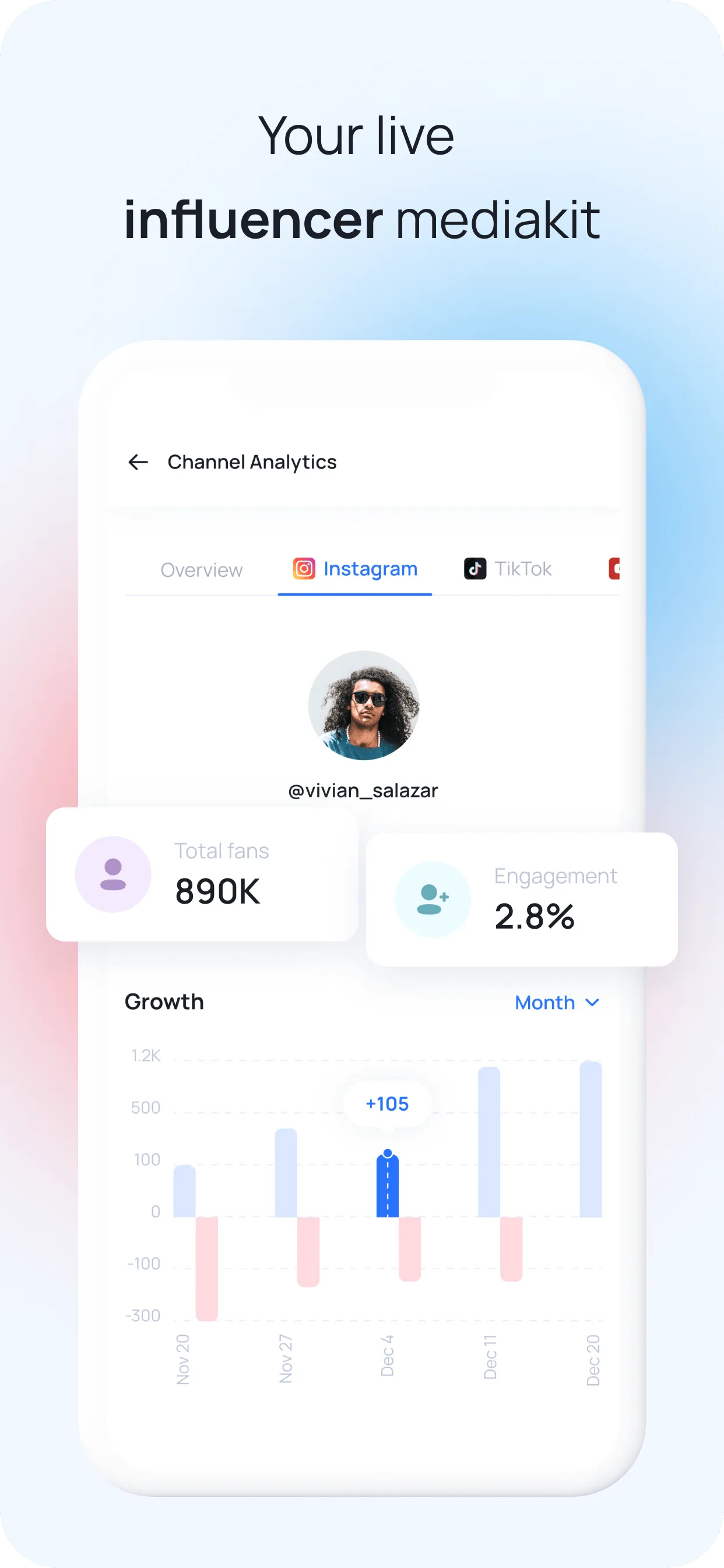
78% of brands verify influencer metrics before partnerships. When they check your PDF against your live profile and find the numbers don’t match, the deal dies. Auto-updating media kits solve this permanently:
Static PDF vs. Live Media Kit
Static PDF
Live Media Kit
This is exactly the problem MySocial’s media kit solves. Connect your social accounts once and your media kit updates automatically every day — follower counts, engagement rates, audience demographics, and content performance. Share a single link with brands and they always see your latest numbers.
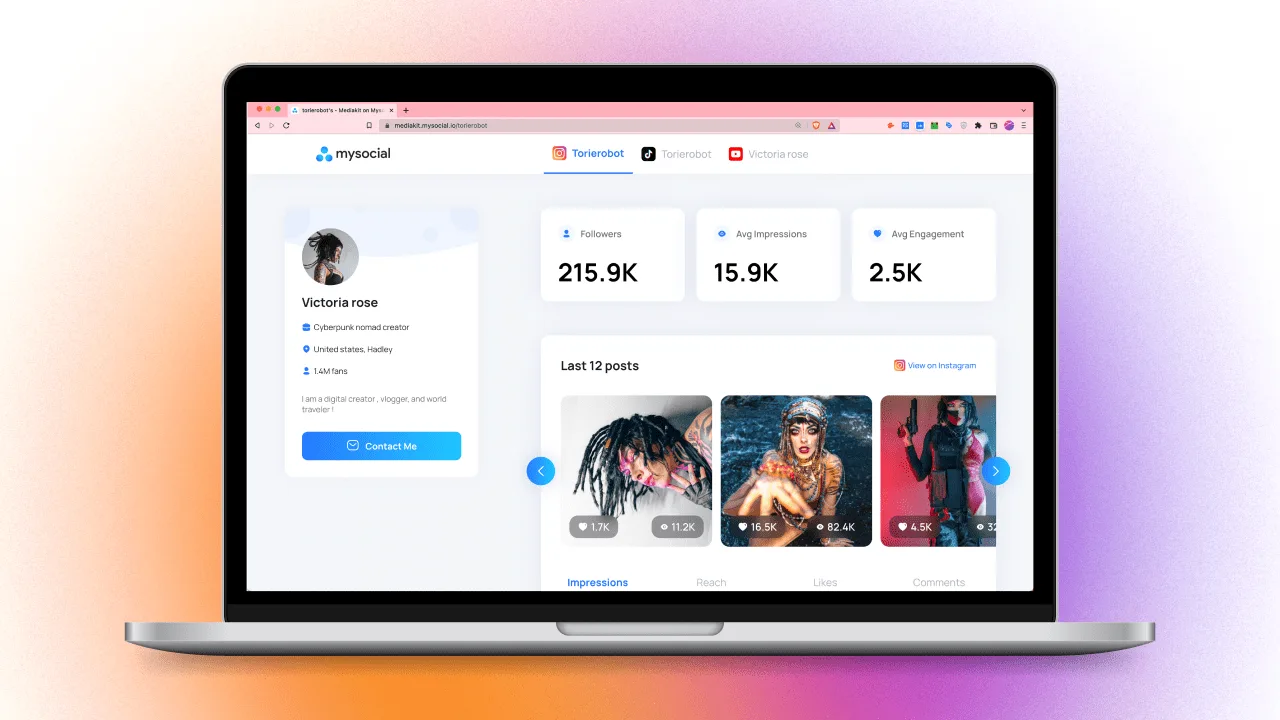
No more PDFs. No more screenshots. No more apologizing for outdated stats in the middle of a negotiation.
Having a great media kit is half the battle. The other half is getting it in front of the right people at the right time.
The 5-Step Pitch Framework
Research the brand first
Know their products, recent campaigns, and target audience. Reference something specific in your pitch to show you’ve done the work — not a copy-paste template.
Lead with their value, not yours
Don’t open with “I’d love to collaborate.” Open with what their brand gets: audience reach, engagement, or a specific content angle that aligns with their current marketing.
Include one standout metric in the email
One number that makes them click: “My last sponsored Reel drove 14K saves and a 5.1% engagement rate.” The media kit link backs it up.
Link your media kit — never attach it
A link loads instantly and stays current. A 5MB PDF attachment gets caught in spam filters or sits unopened. Always share a link.
Follow up once after 5-7 days
One polite follow-up. If no response after that, move on. For the complete email templates and timing strategy, see the full pitching guide.
Key rule: Your email pitch is the hook. Your media kit is the proof. Keep the email under 150 words — let the kit do the heavy lifting.
Brands subconsciously associate the quality of your media kit with the quality of content you’ll produce for them. Design isn’t decoration — it’s credibility.
Consistent visual identity
Use a consistent color palette, typography, and spacing throughout. Your media kit should feel like an extension of your content — not a hastily assembled Google Doc.
Data visualization over raw numbers
A chart showing audience age distribution is scanned in 2 seconds. A paragraph describing the same data takes 15 seconds and gets skipped. Show, don’t tell.
Mobile-optimized layout
Over 60% of brand managers first open pitches on their phone. If your kit only looks good on desktop, you’re losing more than half your audience before they even read it.
Above the fold matters most
The first thing visible — before any scrolling — should be your name, niche, headline metric (engagement rate), and audience size. You have 30 seconds to make the case.
The best creators treat their media kit like a product page — continuously optimizing the positioning, updating content examples, and adding fresh campaign results after every partnership. Each brand deal you close makes your kit stronger for the next one.
For more on the creator monetization journey, explore our guides on how to pitch brands as a creator, how much to charge for a brand deal, and how to find sponsors on Instagram. For Instagram-specific media kit advice, see our Instagram media kit guide.
Connect your social accounts and MySocial generates a professional, auto-updating media kit — verified data, clean design, one shareable link. Always current, always ready.
Create your media kitCreator Monetization & Brand Deals
Related Posts
The best tools for influencers to create content, find sponsors, grow followers, and manage social media like a pro.
A step-by-step system for finding and landing social media sponsors. Build your media kit, prospect brands, pitch professionally, and close repeat deals.
Pricing framework for creator sponsorships. Base rates, add-on pricing for usage rights, tiered packages, and negotiation tactics.