

Best Social Media MCP Servers: An Honest Comparison
14 social media MCP servers, four different jobs. Postiz wins publishing, Supermetrics wins reporting — and Mysocial wins the one nobody else does.


Quick answers
A UGC creator produces content for brands to use on the brand's own channels — ads, social posts, landing pages. Unlike influencers, UGC creators do not need a large following because brands pay for the content itself, not for distribution to your audience. You can be a UGC creator with zero followers.
In 2026 the average UGC video costs around $212. Beginners charge $50-$150 per video, intermediate creators $150-$500, and experienced specialists $500-$1,500+. Packages of 3-5 videos bundled together increase deal value by 15-20% for brands while raising your total earnings per project.
Create 3-5 spec videos for brands you admire — film content as if they hired you. Post these in a portfolio page or media kit. Then pitch brands directly with your spec work as proof. Most first deals come from cold outreach with strong proof of quality, not inbound requests.
UGC looks and feels like organic content rather than a polished ad. 92% of consumers trust UGC more than traditional advertising, and campaigns using UGC see 29% higher web conversion rates. This authenticity drives higher engagement, click-through rates, and purchase intent.
AI UGC tools are growing fast, but 80% of brands still prefer human creators for authentic content. AI handles high-volume variant testing for ads, while human creators produce hero content that feels genuine. The smartest creators use AI to speed up their workflow — scripting, editing, ideation — rather than compete against it.
UGC creation is one of the fastest-growing income streams in the creator economy — and you do not need a following to start. Brands pay UGC creators for the content itself, not for access to an audience. You film it, they run it as ads, post it on their social feeds, or embed it on product pages.
The barrier to entry is low, but the bar for quality is rising fast. Average UGC pricing dropped 44% in 2025 as new creators flooded the market, and AI UGC tools are pushing prices lower for bottom-tier work. The creators who thrive in 2026 are the ones who treat this as a business — with professional pricing, structured portfolios, and a clear production edge that no AI can replicate.
This is the complete strategy for building a UGC business — from your first spec video to a scalable operation earning $5,000-$15,000+ per month.
92%
Of consumers trust UGC more than traditional brand advertising
$212
Average cost of a single UGC video in 2026 — down 44% from 2024
29%
Higher web conversion rates for campaigns using UGC vs. brand-produced creative
80%
Of brands still prefer human creators over AI-generated UGC
UGC (user-generated content) is content created by real people rather than brand marketing teams. It looks like an organic social post — a product review, a testimonial, a “get ready with me” — but it is produced specifically for a brand to use on their channels.
The distinction from influencer marketing is critical: influencers are paid for distribution (their audience sees it), while UGC creators are paid for the asset (the brand runs it wherever they want). You do not need followers. You need production quality and authentic delivery.
Influencer Model
Brand pays for your audience
Content lives on your channels
Requires large following
Priced per post + audience reach
Engagement rate matters most
UGC Creator Model
Brand pays for the content asset
Content lives on brand’s channels
Requires zero following
Priced per video + usage rights
Production quality matters most
Brands are spending more on UGC than ever because it outperforms their own creative. UGC ads generate higher click-through rates, lower cost-per-acquisition, and stronger purchase intent than brand-produced alternatives. When a real person shows a product in their home, kitchen, or gym, consumers believe it. When a brand shows the same product in a studio, consumers scroll past.
Not all UGC is the same. Understanding the different formats — and which commands premium rates — lets you position yourself strategically instead of competing on price.
Product Reviews
Authentic “I tried this” videos. The most in-demand UGC format for e-commerce brands.
$150-$500 / video
Unboxing Videos
First-impression reveals. High engagement because viewers experience the product vicariously.
$100-$400 / video
Testimonials
Direct-to-camera endorsements. Used in paid ads, landing pages, and email funnels.
$200-$600 / video
Tutorials / How-To
Step-by-step demonstrations. Command premium rates because they require scripting and structure.
$300-$800 / video
Day-in-My-Life
Lifestyle integrations where the product fits naturally into daily routines. Feels organic and relatable.
$250-$700 / video
Photo Stills
Lifestyle product photography for social posts, websites, and ads. Often bundled with video packages.
$50-$150 / photo
The highest-earning UGC creators don’t just offer “videos.” They specialize in a format that aligns with a high-value niche — beauty tutorials, tech reviews, fitness transformations — and position themselves as the go-to for that content type.
Your niche directly dictates your rates. Tech and beauty command the highest UGC fees, while general lifestyle sits at the bottom. Picking the right niche is the single highest-leverage decision in your UGC career.
Average UGC video rates by niche (2026)
Avg. per video
0$ to 500$
Niche
Tech / SaaS
450$Beauty / Skincare
400$Finance / Fintech
380$Health / Fitness
320$Food / Beverage
250$Fashion
220$General Lifestyle
150$Avg. per video
Niche
Source: Compiled from UGC marketplace data, 2025-2026
Niching down makes you more valuable because brands want creators who understand their audience. A skincare brand would rather pay $400 for a creator who knows the difference between niacinamide and hyaluronic acid than $150 for a generalist who needs to be told what to say.
You cannot pitch brands without proof that you can deliver. Your portfolio is your resume — and it does not need to include paid work. Spec content (videos you create for brands without being hired) is how every successful UGC creator starts.
Step 01
Choose an industry where you have natural affinity — beauty, fitness, food, tech, SaaS, fashion. Then pick 3-5 specific brands in that niche you would want to create for. Niching down increases your value because brands want creators who understand their audience.
Step 02
Go to Meta Ad Library and TikTok Creative Center. Search for your target brands and study the UGC-style ads they are already running. Note the hooks, pacing, format, and tone. Your spec work needs to match — or beat — what they are currently using.
Step 03
Film content for those brands as if they hired you. A product review, an unboxing, a 'get ready with me' integration. Make it look organic — not polished, not scripted, not corporate. Brands hire UGC creators specifically because the content looks real. Film 2-3 hooks per video to show versatility.
Step 04
A Notion page, a Carrd site, or a section in your Mysocial media kit. Include your spec videos, a short bio, your niche, your rates, and any relevant demographics (age, location, style). Make it easy for a brand to see your work and contact you in under 30 seconds.
Step 05
Send a short, specific email or DM to each brand: 'I created this UGC concept for [brand] — here's a 30-second testimonial-style video. Would love to discuss creating content like this for your team.' Attach or link the spec video. Include 1-2 metrics if you have them. Cold outreach with proof of quality converts far better than generic pitches.
Step 06
After your first paid project, ask for a written testimonial and add it to your portfolio. Screenshot any performance data the brand shares with you (ad spend, CTR, ROAS). Each completed project makes the next pitch easier. Within 5-10 projects, brands will start coming to you.
Step 07
Once you have 3-5 completed projects, build a structured rate card with clear packages and pricing. Stop negotiating from scratch on every deal — a rate card closes deals 2.5x faster than ad-hoc pricing, and positions you as a professional.
For a deep dive on writing briefs that align brand expectations with your creative process, see our UGC brief template guide. For building a media kit that brands actually respond to, read the complete media kit guide.
The difference between a $100 video and a $1,000 video is not expensive equipment — it is execution. Brands pay premium rates for UGC that looks effortlessly authentic while being technically polished.
Production habits that cap your rates
Starting with a slow intro that takes 5+ seconds to reach the point — brands will reject this instantly
Filming in harsh overhead fluorescent lighting that looks institutional and cheap
Background noise from AC, traffic, or other people — kills audio quality and brand trust
One continuous take with zero cuts — no pacing changes, no energy, no editing craft
Messy backgrounds with distracting clutter that screams 'I don't care about production value'
Over-producing with fancy transitions and graphics — UGC should feel like organic social content
Production habits that increase your rates
Hook in the first 1-2 seconds — a pattern interrupt, a surprising statement, or a text overlay that demands attention
Natural lighting — shoot near windows or during golden hour for warm, flattering light that feels organic
Clean audio — use a wireless lav mic ($30-$50) or wired earbuds for voiceover, and film in quiet spaces
Tight editing — cut dead air ruthlessly, add transitions, keep pacing fast so every second earns its place
Multiple hooks per video — deliver 2-3 different openings for every video. Brands love having options to A/B test
Clean backgrounds — declutter, use neutral settings, maintain visual consistency across deliverables
You do not need expensive gear. The creators charging $500+ per video typically use a setup that costs under $200 total.
The $200 setup that earns $500+ per video
📱 Your smartphone
iPhone 13+ or any flagship Android. Shoot in 4K, 30fps. The camera you already own is more than enough.
$0
🎙️ Wireless lav mic
Clean audio is the #1 factor brands judge. A cheap lav mic beats internal phone audio 10x.
$30-$50
🔆 Ring light or LED panel
Consistent lighting across all shoots, regardless of weather or time of day. Get an adjustable color temperature model.
$25-$60
📐 Phone tripod
Stable footage looks professional. A flexible tripod works for desk setups, shelves, and outdoor shooting.
$15-$30
✂️ CapCut (editing)
Free, powerful, and what most brands expect UGC creators to use. Auto-captions, transitions, green screen, speed ramping.
Free
🧲 Background backdrop
Optional but useful — a clean white or neutral fabric eliminates background distractions and gives a studio feel.
$15-$30
Most UGC creators undercharge because they price per video instead of per package. The 2026 market has standardized around clear pricing tiers. Knowing these benchmarks prevents you from leaving money on the table — or pricing yourself out of the market.
Beginner
0-3 months experience
$50-$150
per video (30-60s)
3-video bundle: $120-$350
5 photos: $30-$75
Intermediate
3-12 months experience
$150-$500
per video (30-60s)
3-video bundle: $400-$1,000
5 photos: $75-$150
Experienced
1+ years experience
$500-$1,500
per video (30-60s)
3-video bundle: $1,200-$3,500
5 photos: $150-$300
Specialist
Proven ROAS / niche expert
$1,000+
per video (30-60s)
Custom packages: $2K-$5K+
Monthly retainers: $3K-$10K+
Packages increase your deal size, reduce the per-video cost for brands (making it easier to say yes), and create a predictable income stream. Brands who buy packages save 15-20% vs. individual videos — and you earn 2-3x more per project.
Starter
Entry-level package
3 short-form videos (15-30s each)
2 hooks per video
1 revision round
30-day organic usage rights
$500-$750
Growth
Best valueMost popular
5 short-form videos + 3 photo stills
2 hooks per video
2 revision rounds
60-day usage + paid ad rights
$1,500-$2,500
Premium
Full production
10 videos + 5 photo stills + raw footage
3 hooks per video
Unlimited revisions
Perpetual usage + whitelisting rights
$4,000-$7,500
For the full breakdown of how to set rates for influencer and UGC work including add-ons, see our guide on how much to charge for a brand deal.
Base rates cover content creation. How the brand uses that content is a separate charge — and it is where top UGC creators double or triple their deal value. Most beginners give away usage rights for free because they do not know to charge for them. Do not make this mistake.
Usage rights add-on pricing (% on top of base rate)
Brand posts to their own feed. Lowest cost, limited reach.
Brand runs your content as paid ads on Meta, TikTok, or YouTube.
Extended ad usage — standard for brands running always-on campaigns.
Brand owns the content forever for any channel. Price it accordingly.
Brand runs ads from your account — appearing as your post. Common on TikTok.
You cannot create for competing brands during the exclusivity period.
Example math: A 5-video Growth package at $2,000 base + 12-month paid ad rights (+60%) + whitelisting (+30%) = $2,000 + $1,200 + $600 = $3,800 total. The add-ons nearly doubled the deal. Always itemize these separately in your rate card so brands see exactly what they are paying for.
The best UGC in the world does not matter if nobody sees it. Client acquisition is the skill that separates hobbyist creators from full-time UGC professionals. Here are the five channels that work in 2026.
Cold outreach with spec work
DM or email brands directly with a spec video you created for them. Personalized outreach with proof of quality converts 5-10x better than generic “I’d love to work together” messages. Target marketing managers and paid media buyers.
UGC marketplaces
Platforms like Billo, Insense, and Trend connect creators with brands. They take 20-30% commission but provide deal flow. Good for building your client base early — then move to direct relationships for higher margins.
Social media portfolio
Post your UGC work on TikTok and Instagram with hashtags like #UGCcreator. Brands actively search these hashtags to find creators. Your social presence becomes a living portfolio that attracts inbound leads.
Sponsor databases
Use tools like Mysocial Sponsors to find brands actively looking for creators. Filter by niche, budget, and platform. Direct access to brand contacts removes the guesswork from outreach.
Use a professional media kit to present your portfolio, rates, and past results in one shareable link. For a complete guide on the outreach process, read how to pitch brands as an influencer — the principles apply equally to UGC. For brands actively looking for creators, explore how to find sponsors in 5 steps.
Most UGC pitches fail because they are generic. “I’d love to work with your brand” is what every creator sends. The pitches that convert follow a specific structure.
The 5-part UGC pitch framework
Open with a specific observation
”I noticed your [Product X] ads on TikTok are getting strong engagement — the hook with the before/after is really effective.”
Introduce yourself with proof
”I’m a UGC creator specializing in [niche]. I’ve created content for [brand 1] and [brand 2] — here’s my portfolio: [link]“
Attach spec work (the differentiator)
“I created this 30-second testimonial concept for [their product] — here’s the video. I’d love to create more like this for your team.”
Include a clear package offer
”My Growth package includes 5 videos with 2 hooks each, 2 revision rounds, and 60-day paid ad rights — starting at $1,500.”
Low-friction CTA
”Would a 15-minute call this week work to discuss? Happy to share my full rate card.”
Pitch mistakes that kill deals
Sending generic "I'd love to collaborate" messages with zero specificity
Pitching without any portfolio or spec work to show — brands have nothing to evaluate
Asking the brand what they need instead of proposing a specific concept
Quoting a single video price instead of a package — makes it easy for brands to say no
Following up 3+ times — persistent pestering burns bridges permanently
Pitch strategies that land clients
Personalize every pitch — reference the brand's recent ads, products, or campaigns. Show you did your homework.
Attach spec work — a 30-second video you made for their product. This is the single highest-conversion outreach tactic.
Include your rate card — structured pricing makes you look professional and removes pricing friction.
Target the right person — find the paid media buyer or marketing manager, not the general info@ email.
Follow up once — a single polite follow-up 5-7 days later doubles your response rate.
AI-generated UGC tools like Arcads, Icon.me, and Creatify are growing fast. They can produce realistic-looking talking-head videos at scale for a fraction of human creator costs. This is the reality of 2026. Ignoring it would be like ignoring stock photography in the 2010s.
But here is the nuance: 80% of brands still prefer human creators for authentic content. AI handles high-volume variant testing — producing 20 ad hooks in an hour to find what performs — while human creators produce the hero content that builds trust and converts at the highest level.
What AI UGC does well
High-volume hook testing (20+ variants fast)
Low-budget ad creative for early-stage brands
Rapid iteration on existing concepts
Localization (dubbing into other languages)
Always-on creative refresh at scale
What human creators do better
Genuine emotional connection and trust
Physical product demonstrations
Complex storytelling and lifestyle integration
Hero ad creative that converts highest
Building long-term brand relationships
The smartest creators are not competing against AI — they are using it. Use AI tools for scripting and ideation to speed up your creative process. Use AI editing tools to cut your post-production time. Let AI handle the commodity work so you can focus on what earns premium rates: authentic, creative, high-conversion hero content.
Once you are consistently landing 3-5 clients per month, you have a business — not a side hustle. Scaling means increasing revenue without proportionally increasing your time.
The UGC scaling playbook
Each completed project adds proof to your portfolio — your rates should increase with your proof
Change outfits and setups between takes — same lighting, same location, multiple deliverables
Editing is the most time-consuming part — outsource it so you can focus on filming and client acquisition
Monthly retainers provide predictable income and reduce the constant hustle for new clients
Charge brands for creative direction, ad strategy, and UGC brief writing — not just content production
Bring on additional creators, editors, and an outreach specialist — transition from freelancer to UGC agency
The UGC income curve is steep early and levels off unless you actively push into retainers and team-building. Here is what realistic monthly earnings look like at each stage.
Realistic monthly UGC income by stage
Monthly income
0$ to 16000$
Stage
Month 1-3 (building)
500$Month 4-6 (momentum)
2000$Month 7-12 (consistent)
4500$Year 2 (specialist)
8000$Year 3+ (agency)
15000$Monthly income
Stage
Source: Compiled from creator income reports, 2025-2026
The jump from Month 1-3 to Month 7-12 is the hardest part. It requires consistent outreach, portfolio building, and rate increases after every project. After 10-15 completed projects, inbound leads start supplementing your outreach and the flywheel accelerates. Track all of your content performance through your analytics dashboard so you can show brands real results.
Never start filming without a signed agreement. Even for small projects. Contracts protect both you and the brand — and they are non-negotiable as you move into higher-value deals.
Deliverables
Exact number of videos, photos, hooks. Video length. File format. Resolution.
Timeline
Delivery date. Revision turnaround. When the brand sends the product.
Usage rights
Organic vs. paid. Duration (30/60/90 days, 6 months, perpetual). Whitelisting. Platforms.
Payment terms
50% upfront, 50% on delivery is standard. Net-30 for retainers. Include late payment fees.
Revisions
Number of rounds included. Cost per additional round. What constitutes a “revision” vs. a “new concept.”
Exclusivity
Whether you can create for competing brands. Duration of exclusivity. Always charge extra for this.
The UGC creators who command the highest rates are the ones who understand paid media. They do not just create content that looks good — they create content that performs in ad campaigns. Understanding what makes ads convert lets you deliver measurable results and justify premium pricing.
Step 01
The first 1-2 seconds decide whether someone watches or scrolls. Film 3 hooks per video: a bold claim ('This changed my skin in 2 weeks'), a question ('Why is nobody talking about this?'), and a visual pattern interrupt (close-up of the product, before/after flash). Hook diversity is the #1 thing brands pay premium rates for.
Step 02
Hook → state the problem the viewer has → amplify the frustration → introduce the product as the solution → show the result. This is the structure behind 90% of winning UGC ads. It works because it mirrors how people naturally make purchase decisions.
Step 03
Product in use beats product on a shelf. Show the texture of the skincare product. Show the food sizzling. Show the app screen. Visual proof is 10x more convincing than verbal claims. Brands pay a premium for creators who intuitively understand visual storytelling.
Step 04
End with a specific CTA: 'Use my code for 20% off,' 'Link in bio,' 'You need to try this.' Weak CTAs ('Check them out') lose conversions. Strong CTAs give the viewer a clear next step and a reason to take it immediately.
Step 05
Vertical 9:16 for TikTok and Reels. 1:1 square for feed posts. 16:9 for YouTube pre-rolls. Deliver in the format the brand needs — and offer multiple formats as an upsell. Use a smart link when brands need to track performance across platforms.
Consistency separates hobbyists from professionals. The most successful UGC creators treat client acquisition like content creation — it runs on a schedule, not on motivation. For a full system on planning your content pipeline, read our guide on how to create a content calendar that grows your audience.
Weekly UGC business routine
Monday — Outreach
Send 10-15 personalized pitches. Research new brands. Update your target list.
Tuesday — Filming
Batch film for 2-3 clients. Prep wardrobe, lighting, and product setups in advance.
Wednesday — Editing
Edit all footage from Tuesday. Create hook variants. Add captions and CTAs.
Thursday — Delivery & Follow-up
Deliver final files. Follow up on pending pitches. Request testimonials from completed projects.
Friday — Portfolio & Spec
Create 1-2 new spec videos. Update your portfolio. Post UGC work on social for inbound leads.
Weekend — Learn & Plan
Study trending ads in your niche. Plan next week’s filming. Review your metrics and adjust rates if needed.
After working with thousands of creators, these are the patterns that consistently hold UGC businesses back. Avoid them early and you will accelerate past the competition.
Habits that keep you under $1K/mo
Trying to serve every niche — brands want specialists, not generalists
Pricing per video without packages — you leave 50-70% of potential revenue on the table
Giving away usage rights for free — especially perpetual or paid ad rights
Working without contracts — even small projects need written agreements
Waiting for inbound leads instead of pitching — passive creators stay broke
Over-investing in expensive equipment — a $200 setup outperforms a $2,000 setup if execution is better
Habits of UGC creators earning $5K+/mo
Specialize in a niche — become known as the go-to creator for beauty, tech, food, or fitness UGC
Use a rate card with packages — structured pricing closes deals faster and increases average order value
Negotiate usage rights separately — add-ons can double your deal value on every project
Request testimonials and track performance — social proof and data make every pitch stronger
Treat outreach as a daily habit — the creators who pitch consistently never run out of work
Invest in audio quality — clean sound is the #1 technical factor brands evaluate
Running a UGC business requires more than a camera and editing app. These tools streamline client acquisition, portfolio presentation, performance tracking, and brand discovery.
A professional, shareable media kit that showcases your UGC portfolio, rates, and verified analytics in one link. Send it in every pitch.
Browse thousands of brands actively looking for creators. Filter by niche, budget, and platform to find the perfect UGC clients.
Track your content performance across platforms. Aggregate the data brands care about — CTR, engagement, reach — and share it directly in pitches.
Create trackable links for your UGC portfolio and pitches. See who clicked, when, and which brands engaged with your rate card.
Generate UGC scripts, hook ideas, and creative concepts in seconds. Speed up your ideation process without sacrificing originality.
Your social memory, connected
Mysocial gives you a professional media kit, verified analytics, sponsor discovery, and AI-powered scripting — everything you need to pitch, price, and close UGC deals.
Free to start. One channel is enough to begin.
Mysocial connects YouTube, Instagram, TikTok, LinkedIn and Threads to one Content Memory that Claude and ChatGPT can use.
User-Generated Content (UGC)
Related Posts
14 social media MCP servers, four different jobs. Postiz wins publishing, Supermetrics wins reporting — and Mysocial wins the one nobody else does.

Content creation turns ideas into finished posts and videos. Learn the five-stage pipeline, current format benchmarks, and how to scale without burnout.
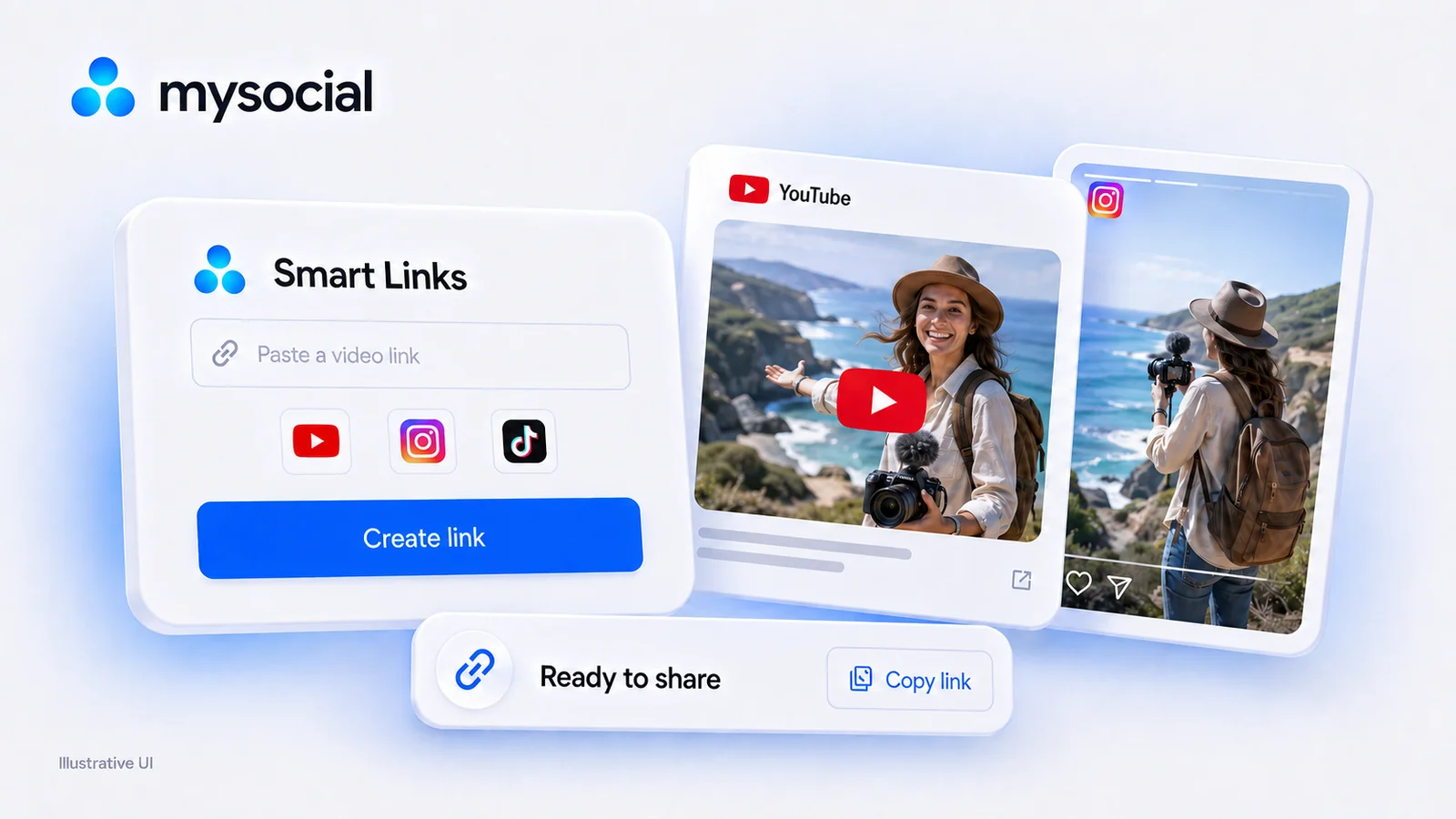
URLgenius charges per click. Mysocial Smart Links are free with no click cap on every plan. Verified 2026 pricing for URLgenius, LinkTwin, OpenUp and U2L.