
5 Tips for Creating Successful TikTok Videos
Production tips that separate viral TikTok videos from scroll-past content -- framing, hooks, captions, backgrounds, and pacing.

Quick answers
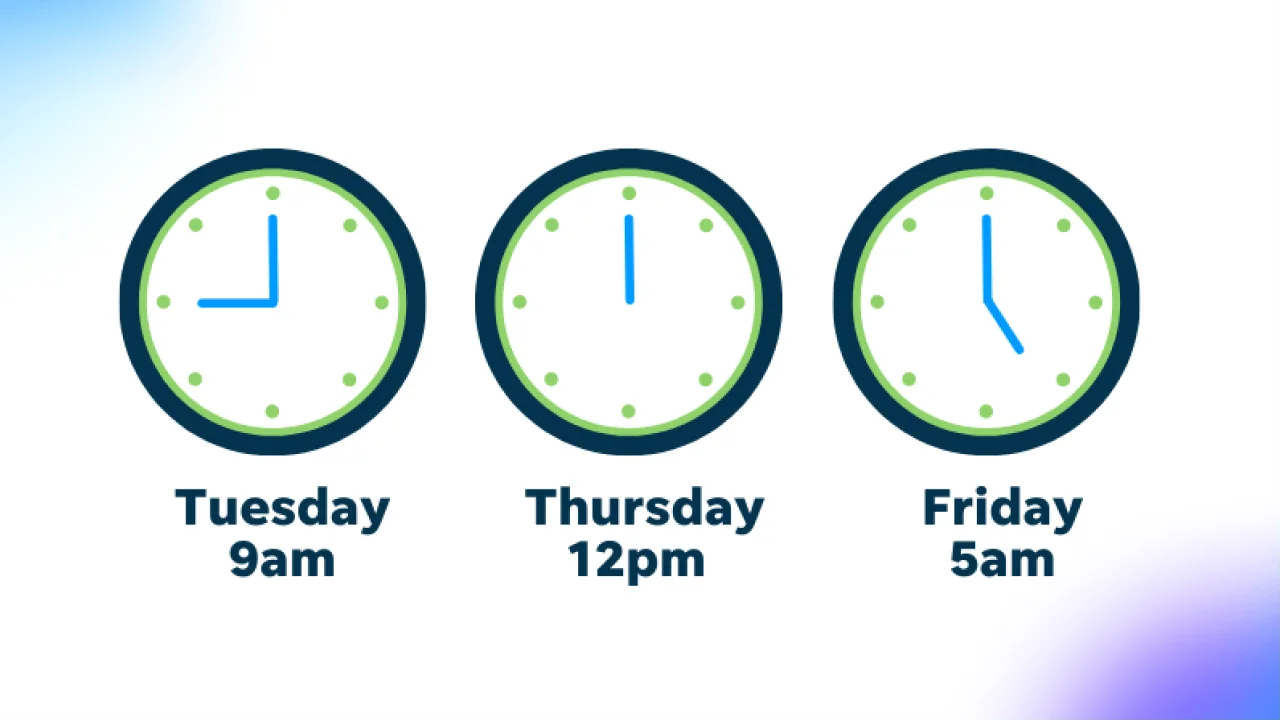
The best overall times are Tuesday at 9 AM, Thursday at noon, and Friday at 5 AM (EST). However, your specific audience may differ, so check TikTok Analytics for when your followers are most active.
Yes. TikTok decides whether to push a video based on early engagement signals like watch time and shares. Posting when your audience is active gives your video the strongest initial boost.
Switch to a TikTok Business Account and open Analytics. The Followers Activity tab shows exactly when your audience is online each day, broken down by hour.
No. Optimal times shift by day. Post during the peak windows for each day of the week and track performance over two to three weeks to find your personal sweet spots.
TikTok’s algorithm makes its biggest decision within the first 30-60 minutes of a post going live. If your video lands when your audience is scrolling, it collects watch time, shares, and comments fast — and the algorithm pushes it further. Post at the wrong hour and even great content gets buried.
This guide gives you the day-by-day posting schedule that research supports, plus a framework for finding the exact windows that work for your audience.
1.5B+
Monthly active users
95 min
Average daily time on app
30-60 min
Critical engagement window
TikTok’s recommendation engine evaluates every video in waves. Each wave either amplifies or kills your reach — and the first one is decided in minutes.
How TikTok decides to push your video
Small test wave
200–500
viewers see your video first
Algorithm evaluates
within the first 30–60 min
Wider distribution
10K–1M+
pushed to For You feeds
Strong early signals → more waves → exponential reach. Weak signals → distribution stops.
The problem: if your test audience isn’t online when you post, that first wave underperforms. Low early engagement signals tell the algorithm the content isn’t worth pushing, regardless of quality.
Timing isn’t everything — strong hooks, clean visuals, and sharp editing still matter most. But posting at peak times gives good content the best possible launch.
These times are based on aggregate data across millions of accounts (EST timezone). Use them as starting points, then refine with your own analytics.
Weekly posting schedule
All times EST
Monday
Tuesday
PeakWednesday
Thursday
PeakFriday
PeakSaturday
Sunday
Tuesday, Thursday, and Friday consistently outperform other days. If you can only post three times a week, those are the days to prioritize.
The early-morning slots (5-7 AM) work because fewer creators post at those hours, which means less competition in the initial test audience wave. Your video gets a cleaner signal.
Generic schedules are a starting point. Your actual best times depend on your niche, audience location, and content format. Here’s how to find them.
Step 01
Open TikTok → Settings → Account → Switch to Business Account. This unlocks the Analytics dashboard with follower demographics, activity data, and content performance metrics.
Step 02
Go to Analytics → Followers → Follower Activity. This shows a heatmap of when your followers are online, broken down by hour and day. Look for the darkest bars — those are your peak windows.
Step 03
Under Analytics → Followers, check the Top Territories section. If 60% of your audience is in the US and 25% in the UK, schedule posts to catch both — a 6 AM EST post hits noon in London.
Step 04
Post at three different times per day across two weeks. Track views, watch time, and shares for each slot. After 14 days, the data reveals which windows consistently outperform.
Step 05
Once you identify your top 2-3 time slots, stick with them for a month. Revisit quarterly — audience behavior shifts with seasons, trends, and platform changes.
Analyze creators in your niche who target the same audience. Open their profiles, check when their top-performing videos were posted, and note patterns. If their highest-engagement content consistently goes live at similar times, that’s a strong signal about when your shared audience is active.
If you’re active on Instagram or YouTube, your audience behavior there can inform your TikTok timing. Followers on one platform often overlap with another. Use Instagram Insights or YouTube Analytics to spot peak activity hours, then test those windows on TikTok.
Posting at the right time is only half the equation. You need to measure which slots actually drive results for your content.
Total likes (inflated by viral outliers)
Follower count alone (doesn't reflect engagement quality)
Views without context (a 2-second view means nothing)
Watch-through rate — what percentage of viewers watched to the end
Shares — the strongest algorithmic signal on TikTok
Comments in the first hour — early engagement triggers wider distribution
Track these metrics per posting time over 2-3 weeks. You’ll quickly see which windows produce the best engagement-per-view ratio — not just the most views.
For deeper analytics beyond what TikTok’s built-in dashboard provides, use MySocial’s reporting tools to consolidate performance data across all your platforms and share real-time reports with sponsors.
The schedule above gives you a proven starting framework. But the real edge comes from combining these timing windows with content that hooks viewers in the first three seconds and a growth strategy that compounds over time.
Start by posting during the peak windows for Tuesday, Thursday, and Friday this week. Check your TikTok Analytics after two weeks, adjust, and lock in the times that work for your audience.
Track performance across TikTok and every other platform in one dashboard. Share real-time reports with brands and prove your value.
Try MySocial freeSocial Media Growth & Algorithms
Related Posts
Production tips that separate viral TikTok videos from scroll-past content -- framing, hooks, captions, backgrounds, and pacing.

MySocial SmartLink vs URLGenius for deep linking. Free tier, pricing, features, and which tool opens your content in-app instead of the browser.
The complete guide to making money on TikTok — brand deals, Creator Rewards, TikTok Shop, affiliate marketing, Series, live gifts, and merchandise.