

Best Social Media MCP Servers: An Honest Comparison
14 social media MCP servers, four different jobs. Postiz wins publishing, Supermetrics wins reporting — and Mysocial wins the one nobody else does.

Quick answers
A strong video marketing strategy starts with a clear purpose, consistent personal branding, and a repeatable content production process. Pair that with cross-platform distribution and data-driven iteration to compound growth over time.
Two to three long-form videos per week plus daily short-form clips is the proven cadence. Consistency matters more than volume -- the algorithm rewards predictable upload schedules over sporadic bursts of content.
Both. Short-form content like Reels, Shorts, and TikToks drives discovery and attracts new viewers. Long-form content builds trust, authority, and watch time. Use short-form to funnel audiences into your long-form library.
Research what your competitors rank for, mine your comment section for recurring questions, and use AI tools to brainstorm variations. Validate ideas by checking search volume and trending topics before you invest production time.
Most creators overcomplicate video marketing. They chase trends, copy formats that don’t fit their niche, and burn out within three months. The creators who actually grow do the opposite — they follow a simple, repeatable framework and execute it consistently. This guide breaks down the 5-step video marketing strategy that turns content into compounding growth.
86%
of businesses use video as a marketing tool
2x
higher engagement vs. static posts
80%
of consumers prefer video over text
Every piece of content you create should trace back to a clear reason for existing. Without purpose, you’re generating noise. With it, every video becomes a strategic asset.
Your purpose falls into one of three categories:
You create because you love the craft. Entertainment, storytelling, artistic exploration.
You create to attract an audience, convert viewers into customers, and build a business.
You create to teach, inspire, or leave something behind that outlasts the algorithm.
Most successful creators blend all three — but one always leads. Identify yours. It shapes your content format, your posting cadence, and which metrics actually matter. A creator focused on legacy measures depth of impact. A creator focused on revenue measures conversion rate.
People subscribe to people, not production quality. Your personal brand — the way you speak, the topics you own, the perspective only you bring — is the competitive moat that no algorithm change can erase.
Weak branding
Copying another creator's format exactly
Switching niches every month chasing trends
Generic intros with no personality or hook
No consistent visual identity across platforms
Strong branding
A recognizable presentation style you own
Deep expertise in 1-2 topics your audience trusts you for
Signature hooks, catchphrases, or formats viewers associate with you
Consistent thumbnails, colors, and tone across every platform
Your personal brand adds the human connection. Your business brand (if you have one) provides the platform. The best creators blend both — a channel that feels personal but operates like a media company. For a deep dive on building your on-camera presence, read our guide on YouTube presenter-led videos that get views.
Not comfortable on camera? That’s fine. Faceless YouTube channels in niches like finance, tech, and compilations regularly hit millions of subscribers with strong scripting and editing alone.
Inspiration is unreliable. A system is not. The creators who publish consistently aren’t more talented — they have a process that removes friction between idea and upload.
Step 01
Generate 20-30 video ideas in one sitting. Pull from audience comments, competitor gaps, trending searches, and your own expertise. Use the Mysocial in Claude or ChatGPT to generate hooks and angles you wouldn't think of manually.
Step 02
Check search volume, browse competitor views on similar topics, and test working titles. Kill ideas that don't have provable demand.
Step 03
Write a hook (first 5 seconds), a promise (what the viewer gets), the body (deliver on the promise), and a CTA (what to do next). Every video follows this skeleton.
Step 04
Film in batches -- 2-4 videos in one session. Edit with retention in mind: cut dead air, add visual pattern interrupts every 30 seconds, and front-load value.
Step 05
Publish the long-form video, then cut 3-5 short-form clips for Reels, Shorts, and TikTok. One production session fuels an entire week of content across platforms.
This isn’t a one-time exercise. It’s a weekly loop. The creators who plan their content calendar systematically outperform those who rely on motivation every single time.
Short-form and long-form serve different functions in your growth engine. Treating them as interchangeable is one of the biggest mistakes creators make.
Purpose: Discovery. Short-form content (Reels, Shorts, TikToks) reaches people who don’t know you yet. It’s your top-of-funnel.
Best for: Quick tips, behind-the-scenes, reactions, trending audio, teasers for long-form content. Cadence: 3-5 clips per week — repurposed from your long-form production, not created from scratch. Key metric: New follower acquisition rate. How many viewers convert to followers per 1,000 views?
Purpose: Trust and authority. Long-form content (8-20 min YouTube videos, podcasts) is where viewers become fans and fans become customers.
Best for: Tutorials, deep dives, storytelling, interviews, case studies. Cadence: 2-3 per week. Quality matters more here — but don’t let perfectionism kill consistency. Key metric: Average view duration. Are viewers staying past the 50% mark?
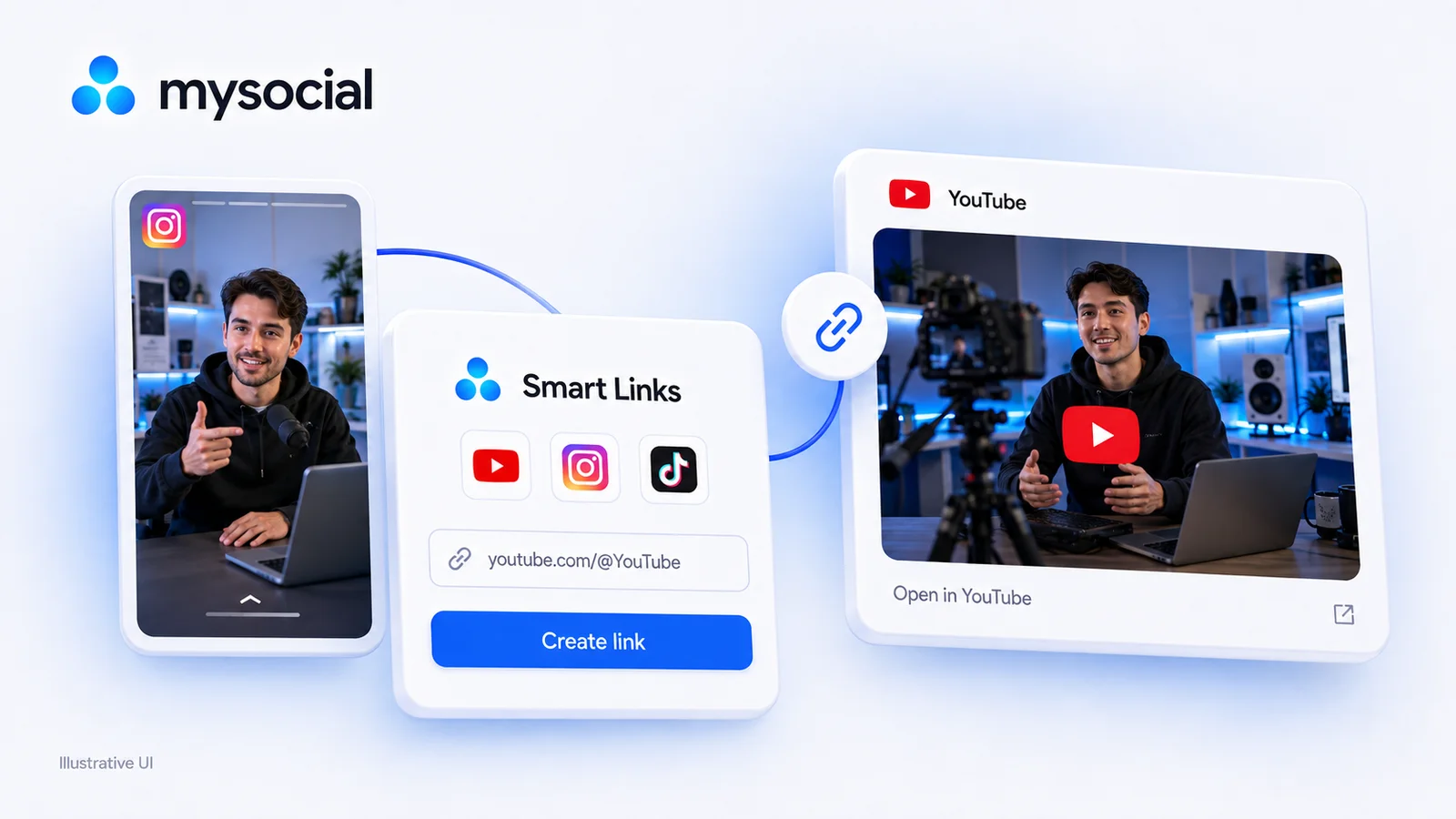
When you share videos across platforms, use deep links to send viewers directly to the app instead of the in-app browser. The difference in watch time and engagement is massive — a SmartLink handles this automatically.
The real power is connecting both formats into one loop. Every short clip points to a long-form video. Every long-form video produces the next week of short clips. One session. One week of content. Compounding.
The Content Flywheel
Film one long-form video and 3-5 short clips in a single session. One afternoon of focused work becomes a full week of content.
Publish long-form to YouTube. Repurpose short clips to Reels, Shorts, and TikTok — each one designed to drive viewers back to the full video.
New viewers discover your long-form library through short clips. Watch time builds trust. Trust turns casual viewers into subscribers.
Subscribers attract sponsors. Ad revenue compounds with every new video. Revenue funds better production — and the cycle accelerates.
Repeat weekly — each cycle compounds on the last
If viewers aren’t flowing from your Shorts to your long-form content, the short-form isn’t converting — fix the hook or the call-to-action that bridges them. Use deep links so fans land in the native app, and a SmartLink handles the routing automatically.
Most creators track vanity metrics (views, likes) and ignore the numbers that actually predict growth. The data tells you exactly what’s working — if you know where to look.
CTR
5-10%
Are your titles and thumbnails compelling enough to earn the click? If CTR is below 5%, the packaging needs work — not the content.
AVD
50%+
Are viewers staying past the halfway mark? If they drop off in the first 30 seconds, your hook needs work. Retention is the algorithm’s favorite signal.
SCR
2-5%
Are viewers subscribing after watching? If not, your CTA is weak or the content isn’t delivering on the promise your title made.
Track these weekly. When a video outperforms, reverse-engineer why — the topic, the hook, the thumbnail, the format. Then do more of that. When a video underperforms, diagnose the drop-off point and fix it in the next one. This is how you turn a content calendar into a growth engine.
For a complete breakdown of which metrics drive real results, read our guide on the most important YouTube metric you’re probably ignoring.
Video marketing compounds. Your first 50 videos teach the algorithm who your audience is. Your next 50 refine that signal. By video 200, the algorithm is actively promoting your content to exactly the right people. Every video you skip is a data point you’ll never get back.
Build a community around your content — respond to every comment in the first hour, ask questions that spark discussion, and collaborate with creators in adjacent niches. The audience you build owns your growth. Platforms change, algorithms shift, but a loyal community follows you everywhere.
You don’t need a bigger budget, better equipment, or more followers. You need a framework and the discipline to execute it. Define your purpose, build your brand, follow a repeatable production process, mix content formats strategically, and let the data guide every decision.
Start with a 30-day content plan to lock in your first month of consistent publishing. Use the Mysocial in Claude or ChatGPT to generate hooks, scripts, and video ideas faster than you could brainstorm alone — and track your growth with real-time reporting so you always know what’s working.
Your social memory, connected
Plan content, generate scripts, and track what's working — all from one dashboard built for creators.
Free to start. One channel is enough to begin.
Mysocial connects YouTube, Instagram, TikTok, LinkedIn and Threads to one Content Memory that Claude and ChatGPT can use.
Social Media Growth & Algorithms
Related Posts
14 social media MCP servers, four different jobs. Postiz wins publishing, Supermetrics wins reporting — and Mysocial wins the one nobody else does.
Content creation turns ideas into finished posts and videos. Learn the five-stage pipeline, current format benchmarks, and how to scale without burnout.
Try a free LinkTwin alternative with a working YouTube link generator. Compare click limits, app-opening behavior and what to check before switching.