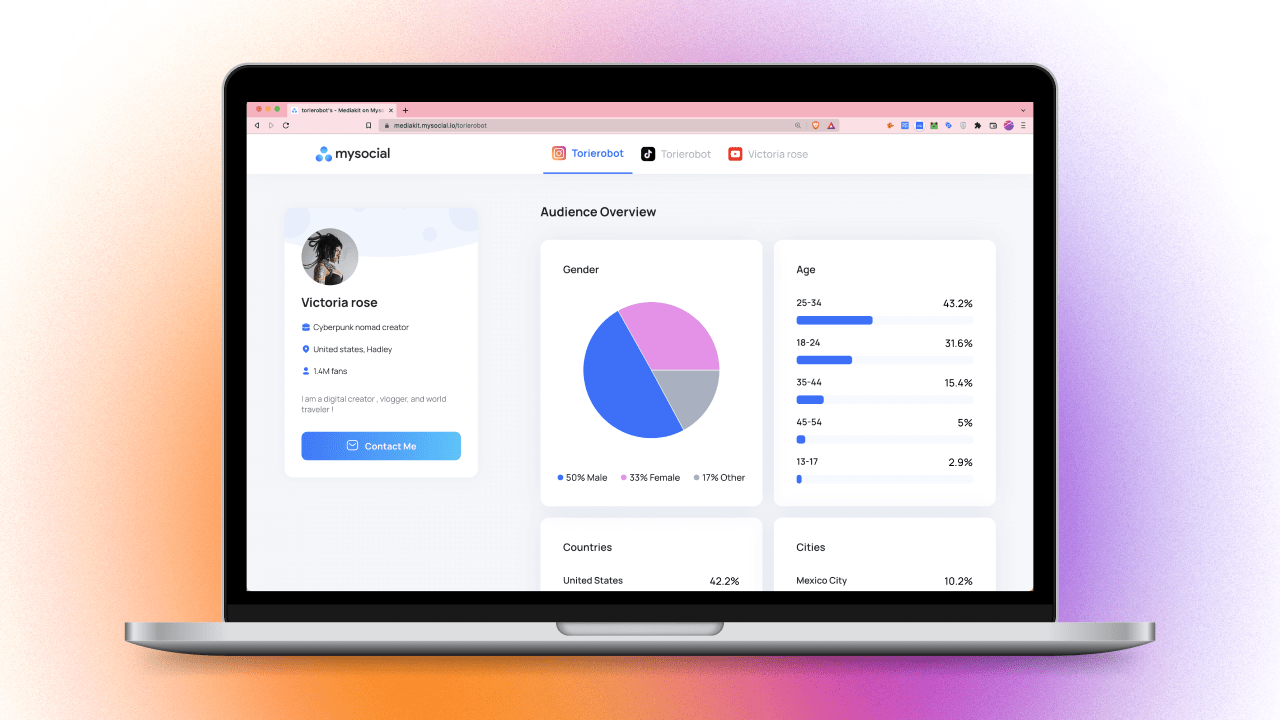
How to Create an Influencer Media Kit That Wins Brand Deals
Build a media kit that wins brand deals. 7 essential sections, metrics to include, rate card tips, and how to stand out from competitors.


Quick answers
There is no single best platform — it depends on your size and goals. Grin is strongest for e-commerce brands with Shopify integration. CreatorIQ dominates enterprise. Aspire excels at UGC-driven paid ads. MySocial is the best free toolkit for creators managing their own brand deals. Evaluate based on your budget, team size, and whether you need discovery, campaign management, or analytics.
Prices range from free (MySocial, Shopify Collabs) to $36,000+ per year (CreatorIQ). Mid-range platforms like Grin start at $399/month, Upfluence requires custom pricing with 12-month contracts, and Creator.co starts at $299/month. Most enterprise platforms require annual commitments and custom quotes.
The five essential features are: creator discovery with fraud detection, campaign workflow management, analytics with ROI attribution, payment and contract automation, and content rights management. Prioritize based on your biggest bottleneck — most brands waste money on platforms with features they never use.
If you run fewer than 5 campaigns per year with under 10 creators, manual management with spreadsheets works. Beyond that, a platform saves significant time — brands using platforms reduce campaign setup time by 60%. The ROI scales with campaign volume.
Businesses generate an average of $5.78 for every dollar spent on influencer marketing. However, 79% of marketers still struggle to measure ROI accurately. Multi-touch attribution models and platform-level tracking are replacing last-click measurement, giving brands a clearer picture of true campaign value.
The influencer marketing industry hit $24 billion in 2024 and is projected to reach $28.5 billion by 2026 (Affiliate Booster). Over 93% of marketers are now using or planning to use influencer partnerships, and 62% are increasing their budgets this year (Linqia).
But the tools you use to manage these partnerships matter as much as the creators you choose. Brands using dedicated platforms reduce campaign setup time by 60% compared to manual processes, and the average return is $5.78 per dollar spent — up from $5.20 in 2023.
This guide compares every major platform by features, pricing, and best use case so you can pick the right tool without overpaying for features you will never use.
$28.5B
Projected influencer marketing spend in 2026
$5.78
Average return per $1 spent on influencer marketing
93%
Of marketers using or planning influencer partnerships
60%
Faster campaign setup with a dedicated platform
Before comparing platforms, understand the five capabilities that separate useful tools from expensive dashboards you will never open.
Essential Platform Capabilities
Creator Discovery & Vetting
Search filters, audience demographics, fake follower detection, niche matching
Campaign Workflow
Briefs, content approval, task tracking, collaboration tools, automated follow-ups
Analytics & ROI Attribution
Real-time dashboards, multi-touch attribution, engagement tracking, EMV calculation
Payments & Contracts
Digital contracts, e-signatures, invoicing, automated creator payments
Content Rights & Repurposing
Usage rights management, content library, whitelisting, cross-channel repurposing
Instagram still dominates influencer marketing spend, but TikTok is closing the gap fast — especially for brands targeting Gen Z and younger millennials.
Brand Budget Allocation by Platform
% of brands
Platform
Source: Affiliate Booster, 2026
The all-in-one creator toolkit. Auto-updating media kit with verified analytics, sponsor database with 10,000+ brand contacts, AI content tools, deep links, and cross-platform reporting. Built for creators who manage their own deals — not agencies managing creators.
Best-in-class audience analytics and fraud detection. 95.5% accuracy across 53+ signals. Useful for both creators (proving audience quality) and brands (vetting creators before deals). Free limited reports available.
Built into Shopify. Creators browse participating brands, apply to campaigns, and earn affiliate commissions — all without leaving the Shopify ecosystem. Best for product-based creators who want passive affiliate income.
The strongest e-commerce integration. Deep Shopify, WooCommerce, and Amazon connections. Automated product seeding, affiliate tracking, and custom reporting. Month-to-month pricing with no long-term contracts. Scales from 15 to 400 active creators per tier.
UGC-focused platform with 90% workflow automation. Strong creator marketplace, content approval pipelines, and whitelisting tools. Best for brands running paid social with creator content — the UGC-to-ad pipeline is its strongest feature.
Multi-platform discovery across 8 channels (Instagram, YouTube, TikTok, Twitch, Pinterest, Twitter, Blogs, WordPress) with 20+ search filters. Strong audience analytics. Best for brands that need to find creators across multiple platforms simultaneously.
Micro and nano-influencer focus. Self-serve plans start at $299/mo, managed services at $1,795/mo. Best for brands that want to run high-volume campaigns with smaller creators rather than a few expensive macro-influencers.
Combines influencer marketing with social media scheduling (Later's core product). AI-powered discovery, content repurposing, and ROI tracking. Official TikTok marketing partner. Best for teams that want scheduling and influencer management in one tool.
The enterprise standard. Used by AB InBev, Unilever, and Disney. Advanced analytics, custom integrations, and a dedicated success team. Overkill for anything under $500K annual influencer spend — but unmatched at scale.
Fashion, beauty, and lifestyle specialist. Built-in shopping platform with 40M+ monthly shoppers. Creators earn commissions through LTK's affiliate infrastructure. Best for lifestyle brands that want an existing, purchase-ready audience.
The biggest mistake brands make is buying a platform based on features they will never use. Match the tool to your actual workflow.
What takes the most time in your current workflow?
• Finding creators? → Prioritize discovery and vetting tools (Upfluence, HypeAuditor)
• Managing campaigns? → Prioritize workflow automation (Grin, Aspire)
• Proving ROI? → Prioritize analytics and attribution (CreatorIQ, Later Influence)
• Creator-side tools? → MySocial for media kits, analytics, and brand deal management
Most brands only use 30-40% of platform features. Don't pay for a full-suite enterprise tool when you only need discovery.
Be honest about what you can afford and who will use it.
• Solo marketer, <$500/mo: MySocial (free) + HypeAuditor ($99/mo) + Shopify Collabs (free)
• Small team, $500-$2K/mo: Grin ($399-$1,149/mo) or Creator.co ($299-$1,795/mo)
• Marketing department, $2K-$5K/mo: Aspire, Upfluence, or Later Influence
• Enterprise, $5K+/mo: CreatorIQ or custom-negotiated Aspire/Grin plans
Watch for hidden costs: 12-month contracts, per-seat pricing, overage fees for exceeding creator limits, and add-on modules for features that should be included.
The platform needs to fit into your existing stack, not replace it.
• E-commerce: Does it integrate with Shopify, WooCommerce, or your storefront? (Grin is strongest here)
• Social platforms: Does it support Instagram, TikTok, and YouTube — or just one? (Upfluence covers 8 platforms)
• CRM: Can it connect to HubSpot, Salesforce, or your existing customer database?
• Ad platforms: Can you push creator content directly to Meta Ads or TikTok Spark Ads? (Aspire excels here)
If a platform requires you to export CSVs and re-import data manually, it is not saving you time.
Never sign an annual contract without testing the platform on a real campaign first.
• Use the free trial (Grin offers 30 days) or request a pilot program
• Run one complete campaign — from discovery through payment — to test the full workflow
• Measure time saved vs. your current manual process
• Check creator experience: Is the onboarding smooth for the creators you invite?
78% of brands use multiple platforms for different campaign types (InfluenceFlow). You may end up using one tool for discovery and another for campaign management — that is fine.
Buy enterprise tools for startup-scale campaigns — CreatorIQ at $36K/year makes no sense if you run 3 campaigns a year
Sign annual contracts without a trial — you will discover deal-breaking limitations only after using it in production
Choose based on database size alone — '200M profiles' means nothing if 90% are inactive or irrelevant to your niche
Ignore fraud detection — influencer fraud cost brands $1.3 billion in 2025. Platforms without fake follower detection leave you exposed
Assume one platform does everything — 78% of brands use multiple tools. A discovery tool + a workflow tool often beats one mediocre all-in-one
Forget about content rights — if the platform does not handle usage rights and whitelisting, you will end up managing that manually anyway
Start with your bottleneck — buy a solution for your actual workflow problem, not the platform with the most features
Run a real campaign during the trial period before signing an annual contract
Check the creator experience — if onboarding is painful for influencers, they will not use it and your campaigns suffer
Factor in total cost: per-seat fees, overage charges, contract minimums, and the time cost of switching later
Use free tools first — MySocial for creator analytics, HypeAuditor for vetting, Shopify Collabs for affiliates — before paying for an all-in-one
Read the contract cancellation terms before signing — many platforms auto-renew with 60-90 day notice requirements
How to Identify the Right Influencers →
The vetting framework for finding creators who actually convert
Running Micro-Influencer Campaigns →
The 7-step framework for high-ROI campaigns with smaller creators
How to Spot Fake Influencer Profiles →
Detect fake followers and engagement fraud before you waste budget
Measuring Influencer Marketing ROI →
The attribution framework for proving real campaign value
MySocial gives you a verified media kit, 10,000+ sponsor contacts, cross-platform analytics, deep links, and AI content tools — everything you need to manage brand deals without paying for an enterprise platform.
Get started freeInfluencer Marketing Strategy
Related Posts
Build a media kit that wins brand deals. 7 essential sections, metrics to include, rate card tips, and how to stand out from competitors.
The best tools for influencers to create content, find sponsors, grow followers, and manage social media like a pro.

How to manage influencer relationships that drive results -- from creative briefs to communication plans that prevent campaign disasters.